Manually posting Facebook content requires constant attention and makes consistent scheduling nearly impossible. A post scheduler automates content publishing by posting at predetermined times, enabling effective content planning and consistent brand presence without manual intervention.
What Is a Facebook Post Scheduler?
A Facebook post scheduler automatically publishes content to your Facebook profile or pages at specified times, eliminating the need for manual posting. These tools enable content planning, batch scheduling, and automated publishing that maintains consistent social media presence.
Unlike manual posting that requires real-time attention, schedulers allow users to plan content in advance and publish automatically according to configured schedules. This capability transforms content management from reactive posting into strategic, planned operations.
Why Schedule Facebook Posts?
Scheduled posting provides several strategic advantages for Facebook content management and marketing operations. Understanding these benefits helps justify investment in scheduling tools and automation systems.
Consistency Benefits
Consistent posting maintains brand visibility and audience engagement. Irregular posting patterns reduce visibility in followers' feeds and can decrease overall account performance. Scheduled posting ensures regular content publication regardless of your availability.
Maintaining consistent posting schedules helps build audience expectations and engagement habits. Followers learn when to expect new content, increasing the likelihood of regular interaction and improved engagement rates.
Time Efficiency
Manual posting requires constant attention and interrupts other work activities. Scheduling enables batch content creation and planning sessions, allowing users to prepare multiple posts during dedicated time blocks rather than posting individually throughout the day.
This efficiency becomes increasingly valuable when managing multiple accounts or posting frequently. Scheduling transforms content management from a continuous task into planned, efficient operations that free time for content creation and strategy development.
Optimal Timing
Posting at optimal times maximizes engagement and reach. Audience activity patterns vary throughout days and weeks, with peak engagement periods offering significantly better performance than off-peak times.
Schedulers enable posting during optimal periods without requiring real-time attention. Users can analyze audience activity data, identify peak engagement times, and schedule content accordingly, maximizing performance without manual timing management.
How MadHub's Facebook Auto Posting Feature Works
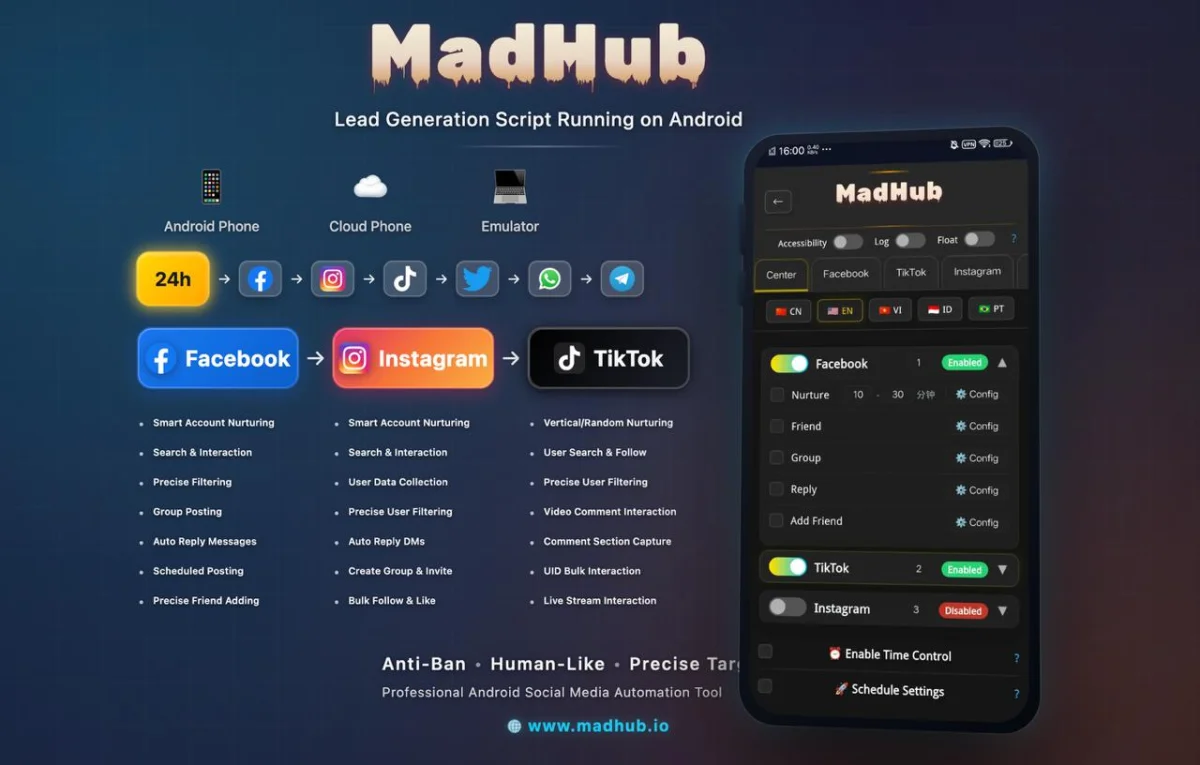
MadHub's Facebook auto posting feature enables automated content publishing on personal homepages with configurable scheduling and timing controls. This Android-based tool operates through a graphical interface, requiring no coding knowledge or script writing.
The tool runs on Android devices, including real Android phones, cloud phones, or Android emulators. This flexibility allows users to choose deployment methods that best suit their technical capabilities and operational requirements.
Core Functionality
MadHub's auto posting feature automatically navigates to your Facebook homepage, creates new posts, and publishes content according to your configuration. The tool handles the entire posting process, from content selection to publication, without requiring manual intervention.
The automation operates continuously, posting content at specified intervals according to your schedule. This consistent activity helps maintain account presence while freeing time for content creation and other marketing activities.
Content Source Configuration
MadHub supports two content management modes: input mode and file mode. Input mode allows direct text entry through the graphical interface, enabling quick content creation for immediate scheduling. Users can enter multiple content variations, and the tool automatically rotates between them to maintain variety.
File mode reads content from text files stored on your Android device, cloud phone, or emulator. This mode supports two operation types: delete mode and loop mode. Delete mode removes content from files after posting, ensuring each piece of content posts only once. Loop mode cycles through file content repeatedly, allowing continuous posting with the same content library.
Both modes support content rotation, automatically selecting different content for each post to maintain variety and engagement. This rotation prevents repetitive posting that might reduce audience interest or engagement rates.
Visibility Settings
Users configure post visibility to control who can see published content. Public posts are visible to everyone, maximizing reach and discoverability. Friends-only posts restrict visibility to your friend network, providing more private sharing options.
Visibility settings enable strategic content distribution based on post objectives. Public posts support brand awareness and audience growth, while friends-only posts enable personal sharing and relationship building within existing networks.
Posting Configuration Options
Users configure posting behavior through several key parameters. The single post count per session setting determines how many posts the tool publishes during one operation cycle. This setting helps control posting frequency and prevents overwhelming followers with excessive content.
Post wait time between multiple posts defaults to 10 minutes, creating natural posting intervals that mimic human behavior. This delay reduces detection risk while ensuring consistent account activity. Users can adjust this interval based on their specific needs and content strategy.
Action interval settings control timing between posting operations, with default settings ranging from 1-2 seconds. These intervals create smooth automation flow without appearing mechanical, maintaining natural posting patterns that reduce detection risk.
Image Insertion Capability
MadHub's auto posting feature supports image insertion, allowing users to enhance posts with visual content. The tool automatically selects images from your device's gallery, enabling rich media posts that generate higher engagement than text-only content.
Image selection occurs automatically during posting, with the tool choosing images from your specified gallery folder. This automation eliminates manual image selection while ensuring visual content accompanies text posts, improving post visibility and interaction rates.
Operation Timing and Safety
The tool includes configurable operation schedules that control when posting occurs. Users can set specific hours for posting operations, aligning content publication with peak audience activity times while allowing account rest periods.
For continuous operation, enable 24/7 posting mode, allowing the tool to post content around the clock. This mode maximizes account presence but requires careful content management and posting frequency control to maintain account safety.
The tool incorporates random timing variations to enhance safety. These variations prevent predictable posting patterns that might trigger Facebook's automated detection systems, helping maintain account security during extended operation periods.
Setting Up Content Scheduling with MadHub
Installation Requirements
MadHub operates exclusively on Android platforms, requiring Android 7.0 or higher. Users can install the tool on real Android phones, cloud phones, or Android emulators, depending on their preferences and technical setup.
For users with physical Android devices, installation involves downloading the MadHub application and completing standard Android app installation procedures. Once installed, the tool runs continuously, executing posting tasks according to your configuration.
Cloud phone services provide virtual Android environments running on remote servers. These services enable 24/7 operation without requiring local device management, making them ideal for users who need continuous automation without dedicating personal devices.
Android emulators offer desktop-based control, allowing users to manage Facebook content scheduling from their computers. Popular emulators like BlueStacks or Nox can run MadHub, providing centralized management capabilities for users who prefer computer-based interfaces.
Initial Configuration
After installing MadHub on your chosen Android platform, access the Facebook auto posting feature through the main menu. The graphical interface displays all configuration options in organized sections, making setup straightforward for users without technical expertise.
Begin by selecting the auto posting function from MadHub's feature menu. The interface presents posting configuration options, content management settings, and operation parameters in clearly labeled sections.
Configuring Content Sources
Choose between input mode and file mode based on your content management preferences. For input mode, navigate to the content input section and enter your posting text directly. You can add multiple content variations, and the tool automatically rotates between them during posting operations.
For file mode, select the file management option and specify the text file containing your posting content. Ensure the file is accessible from your Android device, cloud phone, or emulator storage. Configure whether to use delete mode or loop mode based on your content strategy.
If using delete mode, the tool removes content from files after posting, ensuring each piece posts once. This mode works well for time-sensitive content or campaigns requiring unique posts. Loop mode cycles through file content repeatedly, suitable for evergreen content or ongoing marketing campaigns.
Setting Posting Parameters
Configure single post count per session based on your content strategy. Lower values (1-2 posts per session) maintain subtle presence, while higher values (3-5 posts) increase visibility but require careful timing to avoid overwhelming followers.
Set post wait time between multiple posts, with the default 10-minute interval providing balanced timing. Increase this interval for more conservative posting patterns, or decrease it for more frequent activity, always considering audience expectations and account safety.
Configure action intervals to control timing between posting operations. Default settings (1-2 seconds) provide smooth automation flow, but users can adjust these intervals based on safety preferences and operational requirements.
Image Configuration
Enable image insertion by activating the image selection feature. Specify the gallery folder containing images you want to use, and the tool automatically selects images during posting operations.
Ensure your Android device, cloud phone, or emulator has sufficient images in the specified folder to support your posting frequency. The tool randomly selects images, ensuring visual variety across posts while maintaining automation efficiency.
Operation Schedule Setup
Configure operation timing to match your content strategy and audience activity patterns. Set start times, operation duration, and posting frequency based on when your target audiences are most active.
For continuous operation, enable 24/7 posting mode, allowing the tool to post content around the clock. This mode maximizes account presence but requires careful content management and posting frequency control to maintain account safety.
For scheduled operation, set specific hours when posting should occur. This approach aligns posting with peak audience activity times while allowing account rest periods that reduce detection risk.
Effective Content Planning Strategies
Content Calendar Development
Develop content calendars that organize posts by themes, topics, and posting schedules. Calendars help ensure content variety, maintain posting consistency, and align content with marketing objectives and seasonal events.
Plan content weeks or months in advance, allowing time for content creation, review, and optimization. Calendars enable strategic content distribution that supports long-term marketing goals while maintaining daily posting consistency.
Content Variety Maintenance
Maintain content variety to keep audiences engaged and prevent monotony. Rotate between different content types: educational posts, promotional content, behind-the-scenes content, user-generated content, and engagement-focused posts.
Use MadHub's content rotation features to automatically vary content, ensuring posts don't become repetitive. This variety maintains audience interest and improves overall engagement rates.
Optimal Timing Analysis
Analyze audience activity data to identify peak engagement periods. Facebook Insights provides data on when your followers are most active, enabling strategic scheduling that maximizes post visibility and interaction.
Schedule content during identified peak periods to maximize reach and engagement. This strategic timing improves post performance without requiring real-time attention or manual timing management.
Content Batch Creation
Create content in batches during dedicated time blocks rather than posting individually throughout the day. Batch creation improves efficiency and allows for better content planning and quality control.
Use file mode to store batch-created content, enabling systematic content management and scheduled posting. This approach transforms content creation from reactive to strategic, planned operations.
Benefits of Using MadHub for Content Scheduling
Time Efficiency
Manual posting requires constant attention and interrupts other activities. Scheduling enables batch content preparation and automated publishing, freeing hours daily for content creation, strategy development, and other marketing activities.
The tool's automation handles posting operations automatically, eliminating the need for real-time attention. This efficiency becomes increasingly valuable when managing multiple accounts or posting frequently throughout the day.
Consistency Maintenance
Human posting naturally includes inconsistencies. Busy periods result in missed posting opportunities, while free days might see posting spikes. These inconsistencies can reduce account performance and audience engagement.
MadHub maintains consistent posting schedules, ensuring regular content publication regardless of your availability. This consistency helps build audience expectations and engagement habits that improve long-term account performance.
Strategic Planning
Scheduling enables strategic content planning that aligns with marketing objectives and audience needs. Users can plan content weeks or months in advance, ensuring content supports campaigns, seasonal events, and long-term goals.
Strategic planning improves content quality and relevance, as users have time to develop thoughtful content rather than posting reactively. This planning approach supports better marketing outcomes and audience engagement.
Scalability
Managing multiple accounts or frequent posting becomes impractical with manual methods. Automated scheduling enables scalable content management, allowing users to maintain consistent presence across multiple accounts without proportional time investment.
The tool's ability to handle multiple content sources and posting schedules transforms content management from a linear, time-intensive process into a scalable operation that grows with your needs.
Best Practices for Content Scheduling
Start Conservatively
When beginning automated scheduling, start with conservative settings. Use lower posting frequencies (1-2 posts daily) and shorter operation periods to establish natural patterns gradually.
Monitor account performance and audience responses during initial weeks. If everything proceeds smoothly, gradually increase posting frequency and operation duration while maintaining safety margins that protect account security.
Content Quality Priority
Scheduling improves efficiency, but content quality remains essential for effective Facebook marketing. Focus on creating valuable, relevant content that provides genuine value to your audience.
Use scheduling to distribute quality content consistently rather than using it to post low-value material frequently. High-quality content generates better engagement and builds stronger audience relationships than frequent, low-value posts.
Respect Audience Expectations
Understand your audience's expectations regarding posting frequency and content types. Excessive posting can overwhelm followers and reduce engagement, while insufficient posting can reduce visibility and audience connection.
Configure posting schedules that match audience preferences and engagement patterns. Monitor audience feedback and adjust schedules based on engagement data and follower responses.
Regular Content Updates
Keep scheduled content fresh and relevant by regularly updating content libraries. Review and refresh content files periodically, ensuring scheduled posts remain current and aligned with current marketing objectives.
Use delete mode for time-sensitive content and loop mode for evergreen content, ensuring appropriate content management based on content characteristics and marketing needs.
Monitor and Optimize
Regularly review posting performance and audience engagement. Monitor post reach, engagement rates, and audience feedback to identify what content types and posting times perform best.
Adjust content strategies and posting schedules based on performance data. Optimize content mix, posting frequency, and timing to improve overall account performance and audience engagement.
Technical Requirements and Compatibility
Android Platform Support
MadHub requires Android 7.0 or higher, ensuring compatibility with most modern Android devices and emulators. This Android requirement provides flexibility in deployment options while maintaining broad device support.
The tool's Android-based design offers several advantages. Android's open ecosystem enables flexible installation options, while the platform's widespread adoption ensures users can find suitable deployment methods regardless of their technical capabilities.
Device Deployment Options
Users can choose from three primary deployment methods: real Android phones, cloud phones, or Android emulators. Each option offers distinct advantages depending on individual needs and technical preferences.
Real Android phones provide straightforward setup, requiring only standard app installation. This option suits users who have dedicated devices for automation and prefer simple, direct operation without additional technical complexity.
Cloud phones offer remote access and continuous operation without local device management. These virtual Android environments run on remote servers, enabling operation from any location with internet connectivity while providing 24/7 availability.
Android emulators enable desktop-based control, allowing users to manage Facebook content scheduling from their computers. This option appeals to users who prefer centralized management and want to avoid dedicating physical devices to automation tasks.
Network and Resource Requirements
Stable internet connectivity is essential for MadHub's operation. The tool requires consistent network access to maintain Facebook connections and execute posting operations reliably.
For cloud phone deployments, network requirements are particularly important since all operations occur over internet connections. Users should ensure reliable, high-speed internet access for optimal performance and operation reliability.
MadHub's resource requirements are minimal, making it suitable for various device configurations. The tool operates efficiently in the background, consuming minimal battery and processing resources while maintaining reliable operation.
For emulator deployments, ensure adequate system resources to run both the emulator and MadHub simultaneously. Most modern computers handle this combination without issues, but older systems might require optimization or hardware upgrades.
Common Use Cases
Business Content Marketing
Businesses use scheduled posting to maintain consistent brand presence and support marketing campaigns. Automated scheduling enables businesses to maintain regular content publication while dedicating resources to content creation and customer relationship management.
Scheduled posting supports campaign execution by ensuring content publishes at optimal times without requiring real-time attention. This capability enables businesses to execute complex campaigns while maintaining operational efficiency.
Personal Brand Building
Individuals building personal brands use scheduling to maintain consistent social media presence. Automated posting enables personal brand development without requiring constant attention, allowing individuals to focus on content creation and relationship building.
Scheduling helps personal brands maintain visibility and engagement while managing other professional and personal responsibilities, supporting sustainable brand growth.
Multi-Account Management
Users managing multiple Facebook accounts use scheduling to maintain consistent presence across all accounts. Manual posting becomes impractical when managing numerous accounts, making automation essential for efficient operations.
Automated scheduling enables users to maintain professional presence across multiple accounts without requiring proportional time investment, supporting scalable social media management.
Content Distribution
Content creators distribute content across multiple platforms and accounts to maximize reach and engagement. Manual distribution becomes time-consuming when managing numerous accounts or posting frequently.
Automated scheduling enables efficient content distribution, allowing creators to share content across multiple accounts simultaneously. This efficiency maximizes content reach while minimizing distribution time, enabling creators to focus on content creation.
Troubleshooting Common Issues
Posting Failures
If posts fail to publish, check network connectivity and Facebook account status. Ensure your account hasn't been restricted and that internet connections remain stable during posting operations.
Verify that content files remain accessible if using file mode, ensuring files haven't been moved or deleted. File accessibility issues can prevent content reading and posting operations.
Content Rotation Issues
If content rotation isn't working correctly, review content source configuration. Ensure multiple content variations exist in input mode or that file mode contains sufficient content for rotation.
Check file accessibility if using file mode, ensuring files remain accessible from your Android device, cloud phone, or emulator storage. File permission issues can prevent content reading and rotation.
Image Selection Problems
If images aren't inserting correctly, verify image folder accessibility and file formats. Ensure images are stored in accessible locations and use supported formats (JPG, PNG).
Check that sufficient images exist in specified folders to support your posting frequency. Insufficient images can cause posting failures or repeated image usage that reduces visual variety.
Operation Interruptions
If operations stop unexpectedly, check device resources and network stability. Insufficient device resources or network interruptions can cause operation failures.
For cloud phone deployments, verify server status and network connectivity. Cloud service interruptions can disrupt operations, requiring service restoration before scheduling can resume.
Conclusion
Facebook post schedulers provide essential automation capabilities for efficient content planning and consistent social media presence. MadHub's Facebook auto posting feature offers comprehensive scheduling functionality, enabling automated content publishing with configurable timing, content management, and operation controls while maintaining account safety and operational efficiency.
The tool's Android-based design enables flexible deployment across real devices, cloud phones, and emulators, providing options that suit various user needs and technical capabilities. With configurable posting parameters, content management options, and safety features, MadHub creates efficient content scheduling operations that maximize consistency while minimizing time investment.
Whether you're managing business content marketing, building personal brands, operating multiple accounts, or distributing content efficiently, MadHub's automated scheduling functionality provides scalable, efficient, and safe automation capabilities. The tool's graphical interface eliminates coding requirements, making advanced automation accessible to users without technical expertise.
By combining automated scheduling with quality content creation, strategic planning, and audience-focused optimization, users can build effective content management operations that achieve marketing objectives while maintaining account safety and audience engagement. MadHub's comprehensive feature set and flexible configuration options enable ongoing optimization, allowing users to adapt scheduling strategies as their content needs evolve and marketing objectives develop.